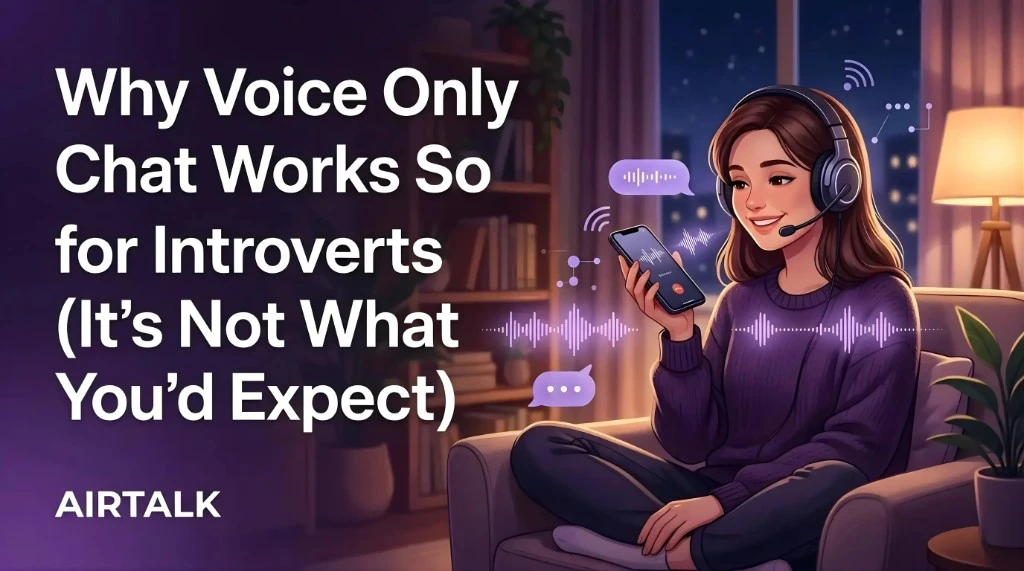
Why Voice-Only Chat Works So Well for Introverts (It's Not What You'd Expect)
If you're an introvert, you already know the feeling. You leave a party early not because something went wrong, but because being around people for too long just costs you. It's not social anxiety, not rudeness, not a character flaw. It's just how your energy works.
The problem is that most ways to meet people online are built for extroverts. Group chats, comment sections, video calls with multiple people, platforms where the goal is to broadcast yourself to as many people as possible. They all carry the same exhausting pressure: be available, be quick, be entertaining, keep up.
Voice-only chat doesn't work that way. And the reason it works so well specifically for introverts has less to do with the technology and more to do with what the technology removes.
What Introversion Actually Means (And What People Get Wrong)
Introversion is not shyness. Susan Cain, whose 2012 book Quiet: The Power of Introverts in a World That Can't Stop Talking brought two decades of psychological research into mainstream conversation, describes introversion as a preference for quieter, less stimulating environments. Introverts aren't afraid of people. They just need a different kind of interaction to feel like themselves.
The key distinction Cain makes is one that most people miss: introverts don't dislike conversation. They dislike shallow conversation. One-on-one, depth-first conversations are exactly where introverts tend to thrive. The exhaustion comes from the performance layer that most social environments demand: maintaining eye contact, filling silence, reacting in real time to a room full of people, making sure your face looks right on camera.
Strip that layer away, and a different kind of conversation becomes possible.
Why Most Online Platforms Feel Draining for Introverts
Every social platform that has scaled successfully did so by optimizing for extroverted behavior. React quickly. Post often. Stay visible. Video calls brought the office meeting into your home and added the specific discomfort of watching yourself talk while trying to listen to someone else.
Text-based chat helps partially, because the asynchronous format lets introverts think before responding. But text strips tone entirely. You lose warmth, humor, hesitation, everything that tells you how the other person is actually feeling. Introverts tend to be careful readers of other people, so communicating with missing information is its own kind of exhausting.
What introverts actually want from a conversation is what most platforms make hardest to find: something real, between two people, where the point is the exchange itself rather than the performance around it.
What Voice-Only Chat Changes for Introverts
No Camera Means No Performance Pressure
Video calls require you to manage two things simultaneously: what you're saying, and how you look while saying it. Research consistently shows that self-focused attention during social interactions increases anxiety and reduces enjoyment. Voice-only removes half that cognitive load entirely. You're just talking. No checking your own face in the corner of the screen, no wondering if you're nodding at the right moments.
One-on-One Format Matches How Introverts Actually Connect
Most introverts aren't drained by all social interaction. They're drained by group social interaction where they have to compete for airtime. Susan Cain's research summary in Quiet makes this clear: introverts consistently prefer one-on-one conversation over group settings, and they tend to have deeper, more substantive exchanges in those contexts.
Random voice chat platforms pair you with one person at a time. That structure isn't accidental. It happens to match exactly the format in which introverts do their best social work.
No Signup Means You Control the Commitment Level
One thing that makes social situations exhausting for introverts is the feeling of being locked in. Once you're at the party, it's socially complicated to leave. Once you've video-called someone, there's an obligation to stay on until a natural endpoint.
A platform with no registration and no ongoing relationship gives introverts full control over when a conversation starts and stops. That control is not a small thing. It's the difference between a conversation feeling like a choice and feeling like a commitment.
What the Research Says About Voice and Connection
Amit Kumar and Nicholas Epley at the University of Texas and University of Chicago studied how people choose communication media and how their choices match their actual experiences. Their 2021 paper, "It's surprisingly nice to hear you," published in the Journal of Experimental Psychology: General (150(3), 595-607), found that voice-based interactions consistently created stronger feelings of connection than text-based ones, even with strangers. People expected calls to be more awkward than emails. They weren't. The voice created something the text couldn't.
For introverts specifically, this matters because the fear of real-time interaction is often what keeps them defaulting to text. The research suggests that fear is consistently miscalibrated. The conversation almost always feels better than the anticipation of it.
Why Anonymous Voice Chat Suits Introverts Better Than Named Platforms
There's a difference between a voice call with a friend or colleague and an anonymous voice call with a stranger. The anonymous version removes something that drains introverts in most social settings: social history.
When you talk to someone who knows you, there's context to manage. Past conversations, impressions you've made, dynamics that have already been established. With a stranger on an anonymous platform, none of that exists. You can be whoever you are right now, in this conversation, without carrying the weight of how you've come across before.
Introverts often describe this as one of the most genuinely restful social experiences available. Not because it's impersonal. Because it's clean.
How AirTALK Fits Into This
AirTALK is voice-only and requires no signup. One person, one conversation, no camera. That's the whole thing.
There's no pitch to make here. Either that format matches what you've been looking for, or it doesn't.
Is Voice Chat Actually Good for Introverts?
Yes, for the right kind of voice chat. Specifically, one-on-one voice chat without video and without signup obligations suits how introverts prefer to connect. The research on voice versus text shows voice creates stronger connections. The research on introversion shows one-on-one conversation is where introverts thrive. Voice-only anonymous chat sits at the intersection of both.
It is not a replacement for real-world friendships or a solution for social anxiety. It's a low-pressure format for genuine one-on-one conversation, which happens to be exactly what introverts are best at.
Frequently Asked Questions
Is voice chat good for introverts?
Yes, particularly voice-only, one-on-one formats without video. The absence of camera pressure, combined with the format introverts naturally prefer for deep conversation, makes it one of the more introvert-compatible ways to connect with people online. Research by Kumar and Epley (2021) found voice creates stronger connection than text, and introverts consistently thrive in exactly the kind of close, focused exchanges that voice chat enables.
Why do introverts prefer one-on-one conversations?
Susan Cain's work in Quiet (2012), drawing on decades of psychological research, explains this clearly: introverts are not energized by social quantity. They're energized by social depth. One-on-one conversation removes the competition for airtime that group settings demand, and allows the kind of focused, substantive exchange where introverts tend to feel most like themselves.
Is anonymous chat good for introverts?
Particularly yes. Anonymous chat removes the social history that makes most conversations feel like performance for introverts. Without a profile to maintain or a reputation to manage, you can simply have the conversation. That absence of context turns out to be freeing rather than cold.
How is voice-only chat different from a regular phone call?
A regular phone call comes with obligation: someone who knows you, a conversation that has history, an expectation of follow-up. Voice-only anonymous chat with a stranger carries none of that. You can be fully present in the conversation without managing a relationship around it. For introverts, that distinction makes a genuine difference.
The Bottom Line
A third to a half of all people are introverts. The internet was not built for them. One-on-one, voice-only, anonymous conversation is the closest thing to the format they naturally prefer that exists online right now.
That's worth knowing.
AirTALK is one place to try it. For more on how anonymous conversations work differently from regular ones, read 10 benefits of talking to strangers online for mental health and how to talk to strangers online safely 2026 guide.