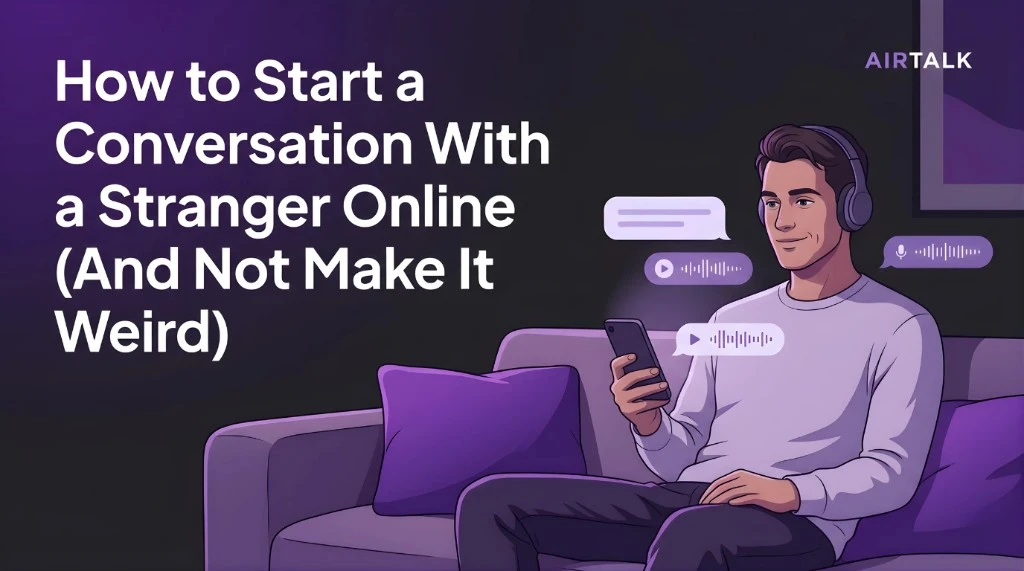
How to Start a Conversation With a Stranger Online (And Not Make It Weird)
Most people delete the first thing they type. Not because it was bad, but because they convinced themselves it sounded off somehow. Then they write something else. Delete that too. Close the tab.
This is the part nobody talks about when they say "just put yourself out there." Starting a conversation with a stranger online feels harder than it should be, and the reason for that is well-documented. We are consistently, dramatically wrong about how these interactions will go.
This guide covers how to start a conversation with a stranger online without overthinking what the research says, what actually works, and why voice tends to beat text for a first exchange with someone you've never met.
What you'll learn:
- Why the fear of starting is almost always worse than actually starting
- Practical conversation openers that don't feel scripted
- Why voice chat reduces the awkwardness that text creates
- What to do when a conversation goes flat
Why Starting Feels So Hard (And Why Your Brain Is Wrong About That)
The fear of reaching out to a stranger is not irrational. It's just miscalibrated.
Nicholas Epley and Juliana Schroeder at the University of Chicago Booth School of Business ran a series of nine experiments across trains, waiting rooms, taxis, and buses. Participants were asked to predict how much they would enjoy talking to a stranger they had never met. Then they actually did it. The results, published in Journal of Experimental Psychology: General (2014, Vol. 143, No. 5) under the title "Mistakenly Seeking Solitude," were consistent: people enjoyed the conversation far more than they predicted they would. The worry was almost always worse than the exchange itself.
This pattern shows up whether you're talking to someone on a commute or chatting with a stranger online. The brain treats social risk as physical risk, and it overestimates the threat. The fix is not better preparation. It's just doing it enough times that you collect evidence the threat was never real.
The first message matters less than you think. The fact that you send it matters more.
How to Start a Conversation With a Stranger Online: What Actually Works
Starting a conversation well is less about having the perfect opener and more about reducing friction on both sides. Here are the approaches that consistently work.
Reference Something Specific
Generic openers ("hey," "what's up," "how are you") get generic responses because they give the other person nothing to work with. A specific observation or question does the opposite. It signals you're paying attention, which makes people feel worth talking to.
If you're on a platform with interest matching, that specific thing is already handed to you. "You listed hiking: where's the best trail you've done?" is infinitely more likely to start a real conversation than a standalone greeting.
Ask Questions That Need More Than One Word
Yes/no questions are conversation dead ends. Open-ended questions keep the exchange moving and give the other person room to actually be themselves. The difference between "do you like music?" and "what have you been listening to lately?" is significant.
The goal in the first two minutes of any conversation with a stranger is to find a single topic where you both have something real to say. One common thread is enough to build from.
Keep the First Message Short
There's a common mistake of writing too much in an opening message. Long openers put pressure on the other person to match the energy or write an equally long reply. A short, direct question or comment is easier to respond to and less overwhelming.
Two sentences is plenty to start. The conversation will expand on its own if there's something there.
Don't Perform. Just Talk
One of the biggest things that makes talking to strangers online feel unnatural is trying to be impressive instead of just being present. You don't need to be funny or interesting or articulate. You need to be responsive. People connect with someone who listens and reacts genuinely, not with someone delivering a well-rehearsed set.
Why Voice Chat Works Better for a First Exchange Than Text
Text is the default for online chat with strangers, but it creates a specific problem for starting conversations: it removes everything that makes communication feel human while leaving in all the pressure to perform.
When you type a message, you edit it. You re-read it. You second-guess the phrasing. Then the other person takes a while to reply and you have no idea if that's because they're thinking or because they didn't like what you said. The gap between messages becomes a space for anxiety to fill.
Voice removes that gap. A 2021 study by Amit Kumar and Nicholas Epley, published in Journal of Experimental Psychology: General (150(3), 595-607), found that voice-based communication with strangers created stronger feelings of connection than text, even when people expected it to feel more awkward. The tone, pace, and warmth in a voice exchange give you real-time information about how the conversation is going, which makes it dramatically easier to calibrate what you say next.
For someone trying to get comfortable with starting conversations with strangers, voice is actually the more forgiving medium, not the scarier one.
What to Do When the Conversation Goes Flat
Not every exchange will take off. This is not a sign you said something wrong. Some conversations just don't have momentum, and recognizing that early is useful.
If things go flat, a few options:
Ask a different kind of question. If you've been talking about surface-level stuff (where are you from, what do you do), try asking about something with more texture: what they're currently into, something they've changed their mind about, a place they want to go. These questions tend to produce more interesting answers.
Let it end cleanly. Not every conversation needs to be saved. A short, friendly exit is better than prolonged awkwardness. "Good talking to you" and moving on is fine.
Don't read the flat conversation as evidence about you. Timing, mood, and general compatibility all determine whether a conversation goes anywhere. None of those are things you control.
This is just how exposure works in practice. The discomfort of starting does not disappear through thinking about it. It shrinks through repetition. An unremarkable conversation that ends cleanly still counts.
Conversation Starters for Online Chat: A Practical List
These are openers designed to generate a real response, not just a polite one.
Interest-based:
- "You mentioned [shared interest]: how long have you been into that?"
- "What got you into [topic]?"
Opinion-based:
- "What's something most people get wrong about [topic you've been discussing]?"
- "What's the last thing you genuinely changed your mind about?"
Experience-based:
- "Where's somewhere you've been that surprised you?"
- "What are you currently working on or looking forward to?"
For voice chat specifically:
- Just say hello and ask one question. The format does most of the work. You don't need a script.
How AirTALK Removes the Hardest Part
The hardest part of any conversation with a stranger is the moment before it starts. AirTALK is built around making that moment easier: voice-only, no signup, no camera, AI moderation running in real time. You're matched based on interests, which means the first thing to talk about is already there.
You can be in a conversation in under 30 seconds. That's the point. The hesitation before starting is what the platform is designed to reduce.
Does Talking to Strangers Online Actually Get Easier?
Yes. The discomfort of starting a conversation with a stranger online is almost entirely driven by anticipated outcomes that don't materialize. Epley and Schroeder's research is consistent on this: the experience of connecting with a stranger is better than people predict, and that gap narrows the more you do it.
Practice is not a metaphor here. It's the mechanism. Each conversation you start, however it goes, updates your brain's threat estimate slightly downward. Over time, the hesitation shrinks not because you've become more confident in some abstract way but because you've collected real evidence that it's fine.
Frequently Asked Questions
How do you start a conversation with a stranger online without being awkward?
Reference something specific rather than opening with a generic greeting. A question tied to a shared interest or something they've mentioned gives the other person something real to respond to. Keep your opener to one or two sentences. The shorter and more direct it is, the easier it is to reply to.
What are good conversation starters for online chat?
The best conversation starters for online chat are interest-specific questions that can't be answered with one word. "What got you into [topic]?" or "What are you currently working on?" both give the other person room to share something real. Avoid openers that put pressure on the other person to be funny or impressive.
Is it weird to chat with strangers online?
No. Millions of people do it every day, and the research on it is consistently positive. Nicholas Epley's work at the University of Chicago found that people dramatically underestimate how much they will enjoy talking to strangers. The hesitation is normal, but it is not accurate.
Why is voice chat easier than text for starting conversations?
Text slows everything down and strips out tone, which leaves you guessing how a message landed. With voice, you hear warmth, pacing, and energy in real time. That feedback loop removes most of the overthinking that makes text conversations with new people difficult. You know within seconds whether the exchange has energy, rather than waiting and speculating.
What if the conversation doesn't go anywhere?
Let it end without overthinking it. Not every exchange needs to be a great conversation. The goal is enough small, low-stakes interactions to build evidence that starting is safe. An unremarkable conversation that ends cleanly is still useful practice.
The Bottom Line
Starting a conversation with a stranger online is harder in anticipation than in practice. That's not optimism. It's what the research shows. The worry consistently outpaces the reality.
The practical takeaway: start with something specific, ask questions that open up rather than close down, and don't aim for impressing. Just aim for genuine. The conversation will either go somewhere or it won't, and both outcomes are fine.
For more on what happens once you're actually talking, read AirTALK vs other random chat platforms and one-on-one voice chat.