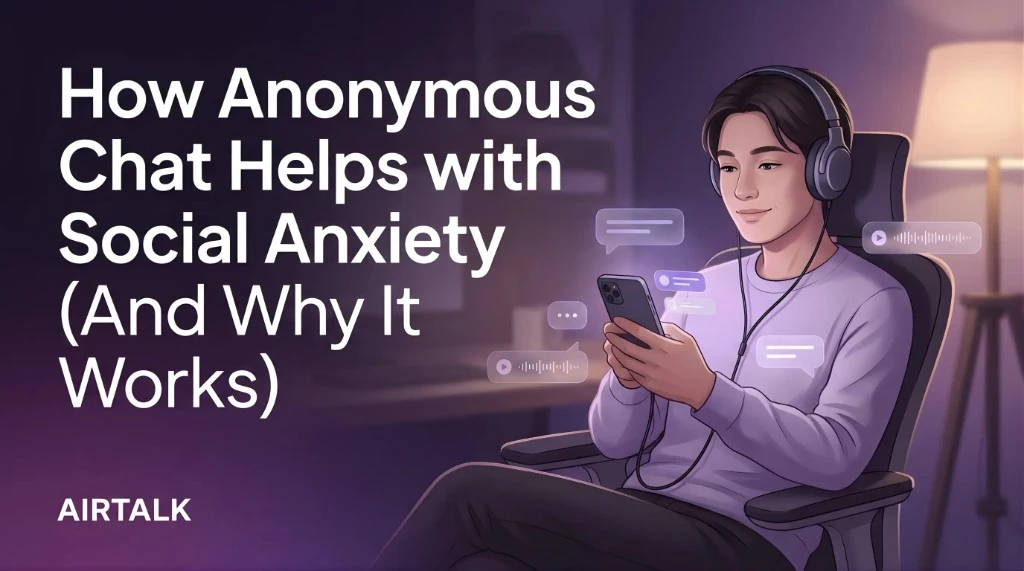
How Anonymous Chat Helps with Social Anxiety (And Why It Works)
Social anxiety disorder affects an estimated 15 million adults in the United States, making it one of the most common mental health conditions in the country, according to the Anxiety and Depression Association of America. Most people who have it never get treatment. Not because they don't want help, but because reaching out to someone, anyone, feels like the hardest part.
Anonymous chat for social anxiety isn't a replacement for therapy. But for a lot of people, it's become something genuinely useful: a low-stakes environment to practice the thing that scares them most. Talking to another person.
This article explains why anonymous conversations work for people with social anxiety, what the research actually says, and what to look for in a platform if you want to try it.
Why Social Anxiety Makes Regular Conversations Feel Impossible
Social anxiety isn't just shyness. It's a specific fear of being judged, embarrassed, or humiliated in social situations, and it's often completely disproportionate to the actual risk involved. You might know logically that texting a friend back won't go badly. But your brain treats it like a threat anyway.
The physiological response is real: elevated heart rate, racing thoughts, the urge to avoid. Here's the difficult part though: avoidance makes it worse. Every time you skip a social situation, your brain reinforces the idea that it was genuinely dangerous. The fear grows instead of shrinking.
This is why conversation practice matters. Not therapy conversation, just talking. The more you do it in low-stakes settings, the less threatening it feels over time.
Picture someone joining a voice chat and staying completely silent for the first two minutes, nearly talking themselves into leaving. Heart racing. Convinced it'll be awkward. Eventually they say "hi" and the other person just responds normally. That unremarkable exchange matters more than any smooth conversation would have. It's evidence. Evidence is what changes anxious thinking, not understanding.
Is Talking to Strangers Good for Social Anxiety?
Yes, research consistently shows it is. People with social anxiety tend to dramatically overestimate how badly conversations will go. Nicholas Epley and Juliana Schroeder at the University of Chicago Booth School of Business ran nine experiments across trains, buses, taxis, and waiting rooms and found the same pattern every time: participants predicted they would enjoy talking to strangers far less than they actually did. The study, "Mistakenly Seeking Solitude," published in the Journal of Experimental Psychology: General (2014, Vol. 143, No. 5), found that the worry was almost always worse than the reality.
Anonymous conversations are particularly useful here because the stakes are lower than almost any other social situation. No ongoing relationship, no shared social circle, no reputation on the line. If it goes badly, it ends. That's it.
What Makes Anonymous Chat Different From Regular Social Interaction
Anonymous chat for social anxiety works differently from a text to a friend or a phone call with a coworker. The core reason is the absence of ongoing consequences.
No Reputation, No Stakes
When you talk to a stranger anonymously, they don't know your name, your history, or your social circle. If the conversation goes awkwardly, it simply ends. No follow-up, no mutual friend who heard about it, no memory of it next week. You're not performing for anyone who knows you.
The Anonymity Effect
This changes the calculation entirely for someone with social anxiety. The stakes are low enough that most people find they can actually start, which for someone with anxiety is the hardest part. Starting is what builds the evidence that the fear was wrong.
Why Voice Chat Specifically Helps More Than Text
There's a real difference between anonymous text chat and anonymous voice chat for anxiety, and it matters.
The Problem With Text
Text chat removes the visual pressure of being seen. But it also slows everything down, adds editing, and strips out the emotional information that makes a conversation feel real. You end up overthinking every word before you send it, which is exactly what social anxiety already makes you do.
Why Voice Works Better
Voice adds something text can't: tone. You hear whether someone is warm or distracted, laughing or just being polite. That immediate feedback breaks the spiral of "did I say something wrong?" that text so often triggers.
A separate study by Amit Kumar and Nicholas Epley, published in the same journal in 2021, found that voice-based interactions consistently created stronger feelings of connection than text-based ones. People underestimated how much better a voice would feel compared to typing. Voice without video hits the right balance for someone managing anxiety: real human connection, no camera pressure.
For someone using online chat to reduce shyness, that combination matters.
How to Use Anonymous Voice Chat to Actually Build Confidence
The benefit isn't in one conversation. It's what happens when you have many of them.
Start With No Expectations
The goal of the first few conversations isn't to be interesting or impressive. Stay in the call for a few minutes. If it ends awkwardly, that's fine. That's actually the point. You survived it.
Track Your Predictions vs. Reality
Before a call, rate how badly you think it will go on a scale of 1 to 10. After, rate how it actually went. Most people with social anxiety find reality consistently scores lower than the prediction. Tracking this builds concrete evidence against the belief that social situations are dangerous.
Use the Anonymity Intentionally
One of the best things about talking to a stranger is that you can be honest in ways you might not be with people who know you. If you're nervous, say so. Most people respond with warmth, not judgment.
Build Up Slowly
Five minutes is enough to shift something. The goal is consistent small exposure, not one big heroic conversation. Therapists call this graduated exposure, and it's the most evidence-backed approach for social anxiety. Anonymous voice chat is an informal, accessible version of the same principle.
What to Look for in a Voice Chat Platform
For someone managing social anxiety, a few things matter more than features.
Voice only, no camera. Video adds performance pressure that works against the whole point. Look for platforms where the camera is never on by default, not just optional.
No signup required. Every extra step is a barrier anxiety will use. The faster you can start, the better.
Active moderation. Anonymous platforms without it expose you to behavior that makes anxiety worse. Real-time AI moderation matters.
At this point, understanding what helps isn't the hard part. Actually starting is. AirTALK is built around exactly that problem: voice-only, no signup, AI moderation running in real time, with country and interest filters so conversations feel less random. There's always someone online, which matters when you're working up the courage to start.
Does Anonymous Chat Help With Social Anxiety?
Yes. Anonymous voice chat helps reduce social anxiety by removing the judgment and ongoing consequences that make social situations feel threatening, while still providing real human interaction. Multiple short conversations over time help retrain the pattern of avoidance that makes social anxiety worse.
It is not a substitute for professional treatment. If social anxiety is significantly affecting your daily life, working with a therapist who uses CBT or exposure therapy is worth pursuing alongside any self-help approach.
Frequently Asked Questions
Is anonymous chat actually good for social anxiety?
It can be genuinely helpful as a practice tool. The anonymity removes the fear of judgment from people who know you, and talking to strangers carries no ongoing consequences. Research by Epley and Schroeder consistently shows people enjoy these conversations far more than they expected to. Works best as a supplement to professional support, not a replacement.
Why is voice chat better than text for anxiety?
Text activates the overthinking loop that social anxiety thrives on: editing messages, waiting for responses, misreading tone. Voice gives you immediate feedback through pacing and warmth, making it easier to gauge how a conversation is actually going. Voice without video removes camera pressure while keeping the human connection that makes practice meaningful.
What if the conversation goes badly?
It's a stranger. The conversation ends and you both move on. No long-term consequences. Over time, surviving awkward conversations is more useful than having smooth ones because it builds direct evidence against the belief that social failure is catastrophic.
Can I use AirTALK if I have severe social anxiety?
Yes, though starting is the hardest part. No signup required, you can be in a call within thirty seconds. Start with just two minutes. The goal isn't a good conversation; it's small repeated exposure. For severe social anxiety, a mental health professional who can guide an exposure hierarchy is strongly recommended alongside this.
The Bottom Line
Social anxiety is driven by avoidance. The way through it is practice. Anonymous voice chat offers a way to practice talking that removes most of the things that make social situations feel dangerous: the camera, the reputation, the ongoing relationship, the need to perform.
It won't fix social anxiety on its own. But for the 15 million Americans who struggle to make the first move in a conversation, it's a place to start. The stakes are low enough that starting is actually possible.
Don't aim for perfection. Just aim for two minutes. AirTALK is free, instant, no signup needed. For more on building confidence in conversation, read our guide on how to talk to strangers online and actually make a real connection and why random chat is so psychologically compelling.