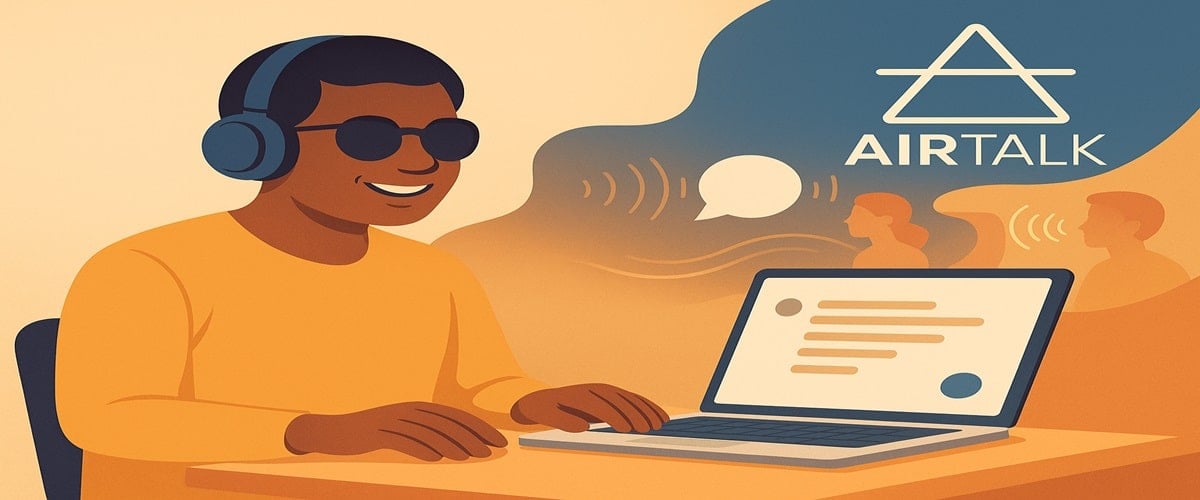
How AirTALK Was Born – The Journey from an Idea to Reality
It started with a voice across an ocean
Back in 2001, I flew to Canada to visit a relative. I was a kid from a small, not-yet-very-connected corner of the world, and he showed me something I had never seen before: a strange little program called MSN Messenger. “Install this when you get home,” he said, “and we’ll be able to talk over the internet — for free.”
I didn’t believe him. I couldn’t picture how a microphone and a computer could carry a voice across an entire ocean. But when I got home, we tried it. And there it was — his voice, live, in my room, half a world away.
I couldn’t see him. I didn’t need to. We just talked, and it felt like he was sitting right next to me. I never forgot that feeling.
The itch that wouldn’t go away
I grew up and became a software engineer, always drawn to the kind of technology that pulls people closer together. For years I spent time on Omegle, chasing that same thrill of meeting a complete stranger online.
But Omegle had a problem. The trolls. The things people would point their cameras at. The way everything slowly became about how you looked instead of what you said. The magic I felt as a kid — a voice from across the ocean, no one watching, no one needing to be seen — was buried under all of it.
So I went looking for the thing I actually wanted: a place to meet random strangers using voice alone. No video. No profiles. Just talk. I searched and searched — and not a single site out there was good enough. Most of them didn’t even exist.
The Name: AirTALK
For a long time the project had no real name — just placeholders like VoiceChat or RandomTalk. None of them fit. Then one evening, while fixing a bug far too late at night, it simply landed:
AirTALK.
“Air” — for the air our voices travel through.
“TALK” — because that’s the whole point.
Simple, clean, exactly like the experience I wanted to build.
Building it
I was an engineer with an idea I couldn’t shake, so I did the only thing that made sense: I built it myself. From my living room, often late into the night — sometimes thrilled, sometimes full of doubt, but always with the same feeling: this needs to exist.
The first version was rough. Calls dropped. Some nights there was barely anyone online. And one question kept echoing: in a world obsessed with visuals and filters, does anyone even want a voice-only space anymore?
Then I shared it with a few small communities, and the messages started coming back:
“This feels freeing.” “It’s like a new kind of therapy.” “It’s so refreshing not to be judged by how I look.”
That’s when I knew it was more than a project. It was a need. AirTALK launched in 2022 as the first platform built entirely around voice-only random chat.
It grew — but it never stopped being about the moment
I didn’t build AirTALK to go viral or to get rich. I built it because I needed it to exist. It grew anyway: today more than 10 million people have used it, and over 20,000 show up to talk every single day. People come here to make real connections — to find friends, to practice a language, and yes, more than a few have met the loves of their lives. Some have written to tell me this site was there for them on a night when nothing else was.
Plenty of clones have copied it since. Most were thrown together fast, to make a quick buck off the AirTALK idea — and they break. AirTALK is the original, and I still pour everything into keeping it fast, stable, and genuinely about people. That’s the part you can feel on a call, and I think it’s why people keep coming back.
If you’ve never tried it, you can talk to strangers by voice in seconds, straight from the homepage.
When was the last time you talked to someone… just talked?
No picture. No typing. No checking their profile. Just listening — and saying something you might not say to anyone else.
It might last a few minutes. You might never know who was on the other end. But that one conversation might be exactly what you needed that day. Or what they needed.
That’s the whole reason AirTALK exists — and it all started with a voice across an ocean.